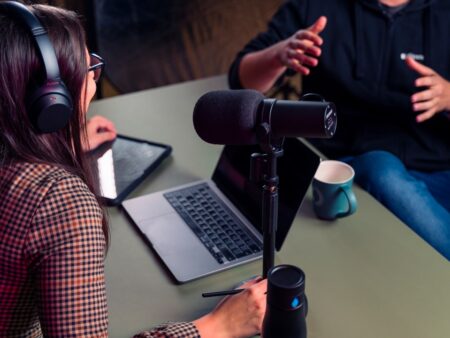

Podcast booking is the process of securing guest appearances on relevant podcasts — either for yourself as a founder or executive, or for clients as a PR or marketing professional. Done right, it’s one of the highest-leverage visibility strategies available to B2B leaders. Done wrong, it costs $3,000–$10,000 a month and generates zero pipeline.
This guide covers everything you need to evaluate the landscape honestly: how booking works, what agencies actually deliver, realistic pricing across every model, when it’s worth hiring vs. doing it yourself, and the 12 questions you must ask before signing any contract.
What Is Podcast Booking? (And Why It Matters for Founders in 2026)
Podcast booking means securing a confirmed interview slot on a podcast where your target audience is listening. For founders and executives, it’s a channel that combines the credibility of earned media with the reach of content marketing — and unlike ads, the content stays discoverable for years.
The numbers behind the channel are hard to ignore. 55% of the U.S. population now listens to podcasts monthly — the first time the channel has crossed the halfway mark. For B2B leaders, that audience skews executive, educated, and purchase-ready. A well-placed interview on a niche industry podcast can put you in front of exactly the buyers your sales team is already trying to reach.
But “podcast guesting” is no longer a novelty tactic. Founders, coaches, authors, and CEOs are increasingly leveraging podcast interviews to establish authority, generate qualified leads, and build trust at scale — and getting booked on meaningful podcasts isn’t as simple as sending a cold email or uploading a bio. It takes strategy, relationships, positioning, and a clear understanding of audience psychology.
That’s the real reason podcast booking has become a professional service category. The mechanics of outreach, show selection, pitch writing, and scheduling are time-intensive enough that many founders either can’t sustain the effort or won’t prioritize it against everything else competing for their attention. High-quality backlinks from podcast show notes boost SEO, podcast episodes stay searchable for years unlike social media posts, and every interview builds direct one-on-one relationships with influential hosts in your niche. The compounding value is real — but only if you’re actually getting booked consistently.
How Podcast Booking Works: DIY vs. Agency
There are two routes: do it yourself using outreach tools and databases, or hand it off to a booking agency that handles research, pitching, scheduling, and logistics. Both work. The question is what your time is worth and how much volume and consistency you need.
The DIY Approach
DIY podcast booking means building a target list of shows, finding host contact information, writing personalized pitches, following up, and coordinating scheduling yourself. The economics look appealing on paper — no agency retainer — but the time cost is significant.
Cold outreach success rates run at 1–10% conversion from pitch to confirmed interview. That means to book four guests per month, you may need to contact 40–400 prospects. Coordination time per confirmed guest — managing scheduling, sending prep materials, calendar changes, technical setup, and follow-up — runs another 3–6 hours.
One documented DIY campaign from the team at Respona offers a useful benchmark: over 13 months, they sent exactly 1,000 pitches total — booking their co-founder on over 100 shows, a 10% success rate and one booking per week over almost two years. That rate is achievable but only with a dedicated outreach function and a disciplined follow-up system. Of those pitches, 270 were follow-up messages — meaning roughly a third of bookings came directly from following up.
The honest tradeoff: DIY works if you have an operator or VA dedicated to outreach, a clear system for show research, and the patience to treat it as an ongoing campaign rather than a one-time push. If you’re a founder doing this yourself between board meetings, the consistency usually breaks down within 60–90 days.
The Agency Approach
A booking agency handles the heavy lifting — finding shows, making introductions, and handling the back-and-forth — so you can focus on showing up and delivering value. In practice, that means a dedicated team doing show research, writing custom pitches, managing host relationships, coordinating scheduling, and often preparing you for the interview itself.
The service types vary. The main categories include full-service agencies that handle every level from pitching to prep, done-for-you booking companies focused on outreach and scheduling, DIY platforms with subscription-based databases where you pitch shows yourself, and marketplace models where hosts and guests connect directly.
Agencies offer several key advantages: access to a broader network of potential placements including high-profile shows, significant time savings so you can focus on your core business, and professional handling of scheduling and communication — which can be extremely time-consuming.
The tradeoff is cost and control. You’re trusting someone else to represent your brand in outreach emails to hosts. If the pitches are generic or the shows are poorly matched to your audience, you’ll spend time recording interviews that generate no business impact.
What Podcast Booking Agencies Actually Deliver
The deliverables vary significantly by agency tier and price point. Before signing any contract, understand exactly which of these services are included — and at what quality level.
Pitch Volume and Response Rates
Most agencies send between 20–60 personalized pitches per month on your behalf, targeting shows where you’re a strong audience fit. Response rates from well-run campaigns tend to run meaningfully higher than cold DIY outreach because agencies have existing host relationships and optimized pitch formats. Professional booking services achieve 20–40% success rates through strategic targeting, compared to the 1–10% conversion rate typical of first-time cold outreach campaigns.
That said, pitch volume alone is not a proxy for value. Bad outreach hurts your brand. If a company is sending bad cold emails, it ultimately hurts you or your brand — so you want to work with a company that doesn’t annoy hosts. Ask agencies for examples of pitches they’ve sent and, ideally, evidence that hosts respond positively to their outreach style.
Show Selection and Quality Control
Show selection is where most agencies either earn their retainer or waste it. A mediocre agency will book you on anything with a download count above a threshold. A strong agency validates audience fit before pitching.
The key question is how an agency validates that a show’s audience matches your ideal customer profile — not just the show’s topic category. Most agencies completely fail at this. They look at your industry and make surface-level assumptions — “you’re in the marketing space, let me get you on business podcasts” — without doing any real audience validation or applying a systematic vetting framework.
Better agencies use minimum criteria like episode count, recency, engagement signals, and audience demographics before adding a show to your target list. Show research should identify high-quality podcasts with a minimum of 30 episodes and active engagement — though for most B2B clients targeting revenue outcomes, the bar should be significantly higher than the floor.
Prep and Post-Interview Support
Full-service agencies go well beyond booking. The process typically starts with a strategy session to discuss your expertise and ideal audience, followed by developing a professional one-sheet or media kit and a compelling pitch. Once materials are ready, the agency begins targeted outreach and coordinates all scheduling details when a host expresses interest.
A good service will also help you prepare for interviews, providing background on the show, the host, and potential questions — and after the interview is recorded, they follow up to get the live link and guide you on how to best promote your appearance.
At the premium end, some agencies include content repurposing — turning your interview into social posts, email newsletter content, and blog assets — which significantly extends the ROI of each appearance.
| Service Component | Entry-Level Agency | Mid-Tier Agency | Full-Service / Premium |
|---|---|---|---|
| Show Research & Vetting | Basic keyword/category matching | Audience size + niche filtering | ICP validation, demographics review |
| Pitch Writing | Template-based with light personalization | Semi-custom per show | Fully bespoke, host-specific angles |
| Outreach Volume | 20–40 pitches/month | 30–60 pitches/month | Curated 20–40 high-quality pitches |
| Guaranteed Bookings | Usually not guaranteed | 2–4/month guaranteed | 4–8+/month guaranteed |
| Scheduling & Coordination | Included | Included | Included + replacement guarantee |
| Interview Prep | Not included | Basic briefing doc | Full coaching + strategy call |
| Media Kit / One-Sheet | Sometimes included | Included | Included + messaging strategy |
| Post-Interview Support | Not included | Live link tracking | Content repurposing, ROI reporting |
| Typical Monthly Cost | $700–$1,500 | $1,500–$3,500 | $3,500–$10,000+ |
What Podcast Booking Costs: Pricing Models Explained
Podcast booking agency pricing ranges from around $700/month for entry-level guaranteed placements to $10,000+/month for strategic, full-service campaigns targeting top-tier shows. The model you choose matters as much as the price.
Monthly Retainers ($2K–$10K+)
The retainer model is the industry standard for ongoing campaigns. You pay a fixed monthly fee for a defined scope of work — typically a guaranteed number of bookings per month, custom pitching, and logistics management.
Professional podcast booking services typically range from $1,000 to $5,000+ per month depending on the volume and caliber of shows. In practice, the market breaks into three tiers:
Entry-level retainers ($700–$1,500/month): Starter packages from agencies like Podcast Bookers start around $700–$900 per month for 2–4 bookings, while more established agencies are in the $1,500 to $2,500 per month range for a similar number of placements. These packages work for coaches, consultants, and solo founders testing podcast guesting as a channel.
Mid-market retainers ($1,500–$3,500/month): Agencies like Podcast Ally offer plans at $2,100/month on a 4-month plan or $1,800/month on a 12-month plan, with custom pitch angles, media kit creation, full booking management, interview prep, and follow-up guidance. This tier is common among B2B service businesses and founders with a defined ICP.
Premium retainers ($4,000–$10,000+/month): At this tier, you get deeper strategy, media training, and a focus on landing bigger, more influential podcasts. Agencies like Lemonpie, known for their strategic approach, can charge $4,999+ per month. Enterprise-grade campaigns with content repurposing, dedicated strategists, and full-funnel tracking can reach $10,000/month and above.
Pay-Per-Placement Models
Some agencies and freelancers charge per confirmed booking rather than a flat monthly retainer. The appeal is obvious — you only pay when a result is delivered. The reality is more complicated.
Some freelancers or smaller agencies charge on a per-booking basis — you pay only for a confirmed booking. This can seem appealing, but the cost per placement is often high to account for the work involved. Expect to pay anywhere from $200 for a placement on a smaller show to over $1,000 for a spot on a more prominent podcast.
The deeper risk: “Pay-per-booking” models often incentivize agencies to book guests on low-tier or “pay-to-play” shows just to hit a quota. When an agency’s revenue depends on placement volume rather than placement quality, their incentives are misaligned with yours. You may end up with a long list of interviews that reach no one in your target market.
Hybrid and Performance-Based Options
Some agencies offer hybrid models — a lower base retainer with a per-placement fee above a guaranteed minimum, or tiered pricing based on show audience size. These structures attempt to balance the agency’s risk with the client’s desire for accountable results.
A few agencies also offer one-time “VIP day” or project-based engagements for founders who want to launch a podcast tour around a specific event — a book launch, product release, or funding announcement. Some agencies offer a $3,497 one-time VIP day option as an alternative to ongoing monthly engagements.
Whatever model you evaluate, ask for a clear breakdown of what’s guaranteed versus best-effort, and what happens if a booked show cancels. A replacement guarantee — where the agency secures a replacement booking at no extra charge if a show host cancels — is a hallmark of professional agencies and worth requiring in any contract.
When to Hire a Booking Agency (And When to DIY)
The right answer depends on four variables: your time, your budget, the volume you need, and the seniority of the shows you’re targeting. Neither path is universally correct.
Hire an agency when:
You need consistent volume (4+ bookings per month) and don’t have an in-house operator to manage outreach. Guest booking can consume 100–200 hours monthly when done in-house — at executive opportunity cost rates, that’s $15,000–$40,000 in time investment before you record a single episode. If your hourly value is high, the math favors delegation quickly.
You’re targeting mid-to-large shows where host relationships matter. Established agencies have existing rapport with producers and hosts that gets their pitches read ahead of cold inboxes.
You want a “done-for-you” campaign with predictable delivery. Booking yourself consistently month after month is a lot of work — it’s also demoralizing when you’re not seeing results and struggling to maintain a continuous stream of bookings. Agencies maintain momentum when your internal attention shifts.
DIY when:
You’re early-stage and testing whether podcast guesting resonates for your niche before committing budget. A few months of manual outreach using a platform like a podcast database tool will tell you more about your acceptance rate and audience fit than any agency promise.
You have a VA or junior operator who can be trained on outreach. Virtual assistants and in-house assistants are cost-effective and good for initial, easier-to-get opportunities — though they may lack industry connections and specialized knowledge, and tend to secure spots on smaller podcasts with limited reach.
You’re a podcaster looking to book guests rather than be a guest yourself. Guest booking for your own show is a different workflow — more relationship-driven, less dependent on agency infrastructure.
Note that most agencies recommend spending more than just a month or two pursuing podcast guesting as a marketing strategy — it takes at least six months to accumulate enough interviews and time to really see meaningful ROI. Don’t hire an agency expecting leads in week three. The compounding visibility effect is real, but it’s measured in quarters, not weeks.
At podcastagencynetwork, we’ve vetted agencies across every price tier and use case. If you’re not sure which approach fits your goals, our comparison tools let you filter by service type, budget, and niche — without having to sit through five sales calls first.
How to Vet a Podcast Booking Agency: 12 Questions to Ask
Most agencies will tell you what you want to hear on a sales call. These questions are designed to separate agencies that deliver from those that merely sound credible.
1. How do you validate audience fit before pitching a show?
Look for a specific process — not “we research shows in your niche.” The right question is: “How do you actually validate that the audience you’re getting me in front of matches my ideal client profile?” If they don’t have a clear, data-driven process for validating audience alignment, they’re taking a spray-and-pray approach with your time and money.
2. Can I see examples of pitches you’ve sent on behalf of similar clients?
Bad outreach hurts your brand — so ask if they can point to positive feedback from podcast hosts on their outreach. The best agencies can show you unsolicited emails from hosts thanking them for the quality and thoughtfulness of their pitches.
3. What’s your average booking rate (pitches sent to confirmed interviews)?
A reputable agency should be able to give you an honest range. Vague answers or refusal to share numbers is a flag.
4. What shows have you placed clients on in my industry in the last 90 days?
Looking at an agency’s current roster of clients can tell you a lot about the quality of their work and what they specialize in. If they seem evasive about sharing examples or their client list is difficult to find online, that’s a red flag.
5. How many clients are you managing at one time, and how many are in my niche?
Oversaturation in a niche is a real problem. If the same agency is booking three competing companies on the same shows, everyone’s positioning suffers.
6. Who writes the pitches — a dedicated team member or AI/template tools?
Custom pitching means tailored, one-to-one outreach to hosts rather than copy-paste templates. Ask to see the actual human responsible for your account’s outreach.
7. What’s included in your show minimum standards — download count, episode history, active publishing cadence?
Any serious agency should have documented minimum criteria. An agency that can’t articulate their quality floor will book you anywhere with a microphone.
8. What happens if a booked show cancels or goes dark before my episode airs?
Ask for a replacement guarantee in writing. This is standard at reputable agencies and non-negotiable at the price points most founders are paying.
9. What’s the contract length and what are the exit terms?
When reviewing a booking service’s process, don’t be afraid to ask questions in any area. If something feels off about the process, vetting criteria, timelines, or reporting methods, and they fail to explain it, that might be your cue to look elsewhere. Avoid 12-month lock-ins with no performance milestones.
10. How do you measure ROI and what reporting do you provide?
The businesses that generate the best returns from podcast appearances don’t care about vanity metrics — they care about audience alignment, conversion systems, attribution tracking, and measurable ROI. If an agency’s reporting stops at “episodes booked,” that’s a problem.
11. What’s your onboarding process and how long until my first confirmed booking?
Most reputable agencies should see your first confirmed booking within 2–4 weeks, allowing for a strategic launch phase where they refine your one-sheet and begin high-touch outreach. Longer timelines without explanation signal disorganized operations.
12. What do you need from me to make this work?
A good agency will have clear expectations of your time and involvement. If they claim to need nothing from you, that’s a flag — strong campaigns require founder input on messaging, angles, and audience priorities.
Red Flags and Common Pitfalls
The podcast booking industry has its share of operators who over-promise and under-deliver. These are the patterns that consistently produce wasted budgets.
Promising top 10% reach without audience validation. Agencies often promise to get you on 30, 40, or 50 podcasts, throwing around impressive-sounding stats like “top 10% of all podcasts globally.” You go on dozens of shows, spend hours recording, and wait for leads to roll in. Nothing happens. When you ask the agency what went wrong, they shrug and say podcasts don’t work for your business. The problem wasn’t the channel — it was the targeting.
High booking volume on low-value shows. Pay-per-placement models in particular create incentives to book you anywhere. A show with 200 downloads per episode reaching a general audience is not the same as a 2,000-download show whose listeners are your exact buyer profile. Always ask for download data and audience demographics on proposed shows before approving the list.
Generic mass-email outreach. Be cautious of agencies that rely on generic, mass email outreach. Effective podcast outreach requires personalization and strategy, not copy-and-paste pitches. If a company assures you of more bookings, that might be true, but it rarely drives real business impact on its own.
No curiosity about your business goals. When specific podcast booking agencies don’t seem curious about your short or long-term business goals, they aren’t the right fit. They’ll encourage you to appear on shows where the audience has little interest in your pain points.
Pay-to-play shows disguised as earned placements. Some low-quality agencies submit clients to “pay-to-play” podcasts — shows that charge guests for appearances — without disclosing this. Ask directly whether any of the shows in your campaign charge guests fees. Some hosts attempt to charge for appearances — never accept this as part of a legitimate booking campaign.
Overselling speed of results. Podcast guesting builds compounding authority over time, not instant pipeline. Any agency promising leads within 30 days as a standard outcome is overstating what the channel reliably delivers in a typical timeline.
ROI Expectations: What Good Booking Looks Like
The honest benchmark: a well-run podcast booking campaign at the $2,000–$5,000/month range should deliver 3–6 quality placements per month on shows with engaged, relevant audiences. Measuring results requires more than counting bookings.
Despite strong growth in the channel, nearly half of marketing teams struggle to confidently measure podcast ROI. Teams invest considerable resources in creating compelling episodes, but their analytics don’t connect those efforts to tangible business outcomes. The same is true for guesting campaigns — tracking what actually converts requires intentional attribution setup.
For B2B companies in particular, the ROI calculation is different from consumer brand awareness. Traditional podcasts measure cost per download. B2B podcasts should measure cost per strategic relationship developed. A podcast generating 300 downloads but facilitating four high-value conversations with potential clients or referral partners monthly typically outperforms a 10,000-download podcast with zero strategic relationships by 10–20x in measurable business value.
| Metric | Vanity (Don’t Optimize For) | Value (Track These) |
|---|---|---|
| Volume | Total bookings per month | Bookings on shows matching your ICP |
| Reach | Total download count across all shows | Estimated reach within target buyer segment |
| Engagement | Episode plays / listens | Direct inquiries or traffic attributed to episode |
| SEO Impact | Number of backlinks | Domain authority growth from show note links |
| Pipeline | New social followers post-episode | Sales calls, inbound emails traced to episodes |
| Compounding Value | Individual episode performance | Authority lift over 6-month campaign window |
Good agencies set outcome expectations clearly at onboarding: how many interviews to expect, what the typical ramp period looks like before results accumulate, and what inputs are required from you. Most agencies note that it takes at least six months to accumulate enough interviews and time to really see meaningful ROI from a podcast guesting strategy. Budget for that timeline before evaluating whether the channel is working.
At the premium end of the market, the results can be significant. One leadership development company that partnered with 20 niche business podcasts — having hosts share personal stories rather than generic talking points — saw a 42% increase in qualified leads and a 30% rise in booked consultations within 90 days. Those results required both strong show selection and a clear conversion system on the guest side.
Compare your agency options side by side at podcastagencynetwork. We break down vetted agencies by price tier, niche specialization, included services, and real client feedback — so you can match the right partner to your actual goals rather than whoever shows up first in a Google search.
Frequently Asked Questions
See the FAQ section below for answers to the most common questions about podcast booking, agency pricing, and what to expect from a guesting campaign.
Frequently Asked Questions
How much does a podcast booking agency cost?
Podcast booking agency pricing ranges from around $700/month for entry-level guaranteed placements (2 shows) to $10,000+/month for full-service premium campaigns targeting top-tier shows. Most mid-market retainers for founders and B2B executives run $1,500–$3,500/month for 3–6 guaranteed placements with custom pitching and logistics included.
How long does it take to see results from podcast guesting?
Most reputable agencies set a 6-month window as the minimum before evaluating meaningful ROI from a podcast guesting campaign. Your first confirmed booking typically arrives within 2–4 weeks of onboarding, but the compounding authority effect — the traffic, SEO backlinks, and inbound inquiries — takes 3–6 months of consistent placements to accumulate measurably.
What is a realistic pitch-to-booking conversion rate?
DIY cold outreach typically converts at 1–10% from pitch to confirmed interview. Established booking agencies with host relationships and optimized pitch formats achieve 20–40% success rates through targeted selection. That gap is a large part of what you pay for when you hire an agency.
What is the difference between a podcast booking agency and a marketplace platform?
A podcast booking agency actively researches shows, writes custom pitches, manages host outreach, and handles scheduling on your behalf — you pay a retainer and show up for interviews. A marketplace platform (like PodMatch or Talks.co) creates a profile for you and facilitates direct connections between hosts and potential guests, but the outreach and selection is largely self-managed. Agencies cost significantly more but deliver higher volumes and quality without your ongoing time investment.
What should I watch out for when hiring a podcast booking agency?
Key red flags include: agencies that promise high booking volumes without validating audience fit, pay-per-placement models that incentivize bookings on low-tier shows, generic mass-email outreach rather than personalized pitches, no curiosity about your business goals or ideal customer profile, and contracts longer than 3–6 months with no performance milestones. Always ask to see sample pitches and a list of recent client placements before signing.